- +1 512-591-8295
- [email protected]
- Mon - Fri 9:00 - 16:00

Entrepreneurs usually notice economic shifts long before economists or reporters do, and before larger businesses do. The change rarely begins with dramatic news stories or official recession announcements. Instead, it shows up quietly in day-to-day operations. Calls slow down. Sales cycles stretch. Customers start asking for more time before making decisions.
Meanwhile the headlines may still describe the economy as stable while you’re already starting to feel some impact.
That disconnect happens because small businesses sit closest to the moment where money actually changes hands. Large economic indicators lag behind behavior. When confidence starts to wobble, entrepreneurs see it immediately in conversations with customers, not months later in economic reports.
Right now, several pressures are hitting the economy at the same time. Some are obvious, such as geopolitical conflict (war) affecting energy (oil) markets. Others are quieter but just as powerful, including tariffs that increased costs across many supply chains at a very base level last year.
When those forces combine with the normal caution that consumers always express, they create the kind of slowdown that small businesses feel long before the rest of the economy recognizes it.
Understanding that pattern is important, because what many entrepreneurs are feeling right now is not random. It follows a structure that has appeared repeatedly during periods of economic uncertainty.
Most entrepreneurs assume slowdowns like this are purely economic. Sometimes they are.
But what I’ve seen repeatedly is that uncertain markets don’t create marketing problems — they just expose them.
When spending tightens, businesses with clear positioning and stable demand systems keep moving. Businesses relying on momentum, referrals, or scattered marketing suddenly feel fragile.
Understanding that difference is the real reason this moment matters.
Economic slowdowns rarely begin with layoffs or financial crises. Most begin with hesitation.
Each individual decision seems minor. When thousands of people start making similar choices at the same time, demand begins to soften across the economy.
Once that happens, a predictable chain reaction starts.
This pattern forms what many entrepreneurs recognize as the economic domino effect. It does not require a recession to begin. A shared sense of uncertainty can be enough to slow economic activity, and small businesses tend to feel it earlier than anyone else.
Most entrepreneurs assume the problem during times like this is demand. Sometimes it is. But far more often the real issue is exposure.
When uncertainty hits the economy, weak positioning, fragile lead generation, and scattered marketing systems get exposed almost overnight. Businesses that relied on momentum suddenly discover they were operating without a stable demand engine.
This is exactly the kind of pattern that becomes obvious when you analyze dozens of businesses side-by-side. The surface problem looks like “sales slowing.” The real problem is usually structural.
One of the most misunderstood parts of economic slowdowns is the role of confidence. People do not need to run out of money before they stop spending. Uncertainty alone can change behavior.
When the future feels unpredictable, both consumers and companies tend to preserve cash until conditions feel clearer. They delay decisions that might otherwise happen quickly.
This caution appears in both consumer and business decisions.
Businesses extend purchasing timelines or ask to revisit proposals later in the year. Homeowners postpone discretionary projects such as remodeling or landscaping. Companies review budgets more carefully and avoid new commitments until they feel confident about future revenue.
Entrepreneurs often see this change before economists do because it appears directly in daily operations. Fewer inquiries arrive. Sales cycles stretch longer than usual. Customers request time to “think about it” rather than committing immediately.
Those signals may seem small at first, but they often represent the earliest stage of a broader slowdown.
Global conflicts frequently affect energy markets, and energy costs influence nearly every sector of the economy; especially the current conflict that is directly impacting oil. Transportation, manufacturing, agriculture, and logistics all depend on fuel. When energy prices rise or become unstable, those increases ripple outward.
Shipping becomes more expensive as transportation costs rise. Manufacturers face higher operating expenses. Distributors adjust pricing to account for rising logistics costs. Eventually businesses throughout the supply chain experience higher input costs.
History shows how quickly these effects can spread.
During the 1973 oil embargo following the Yom Kippur War, oil prices rose dramatically from about $2 per barrel to roughly $11 per barrel in a short period. Yes, I know those prices seem ridiculously low now, but that was a 450% increase. Gasoline prices in the United States increased roughly 40% in one month, and shortages appeared across the country. Rising fuel costs reduced household purchasing power and contributed to the stagflation that defined much of the 1970s.
Although the modern economy is structured differently today, energy shocks still influence inflation and consumer spending. Sudden changes in oil markets increase operating costs across industries and place pressure on business margins.
Tariffs introduce another layer of pressure that many entrepreneurs feel directly.
Economically, tariffs function as taxes that consumers pay on imported goods. The businesses importing those goods pay the cost when the products enter the country. That cost usually moves through the supply chain rather than disappearing. We all know that companies have zero desire to absorb those costs long term, so they pass them on to the final buyers.
Small businesses carry much of that burden. Approximately 97% of U.S. companies that import goods are small businesses. When tariffs increase costs on materials, equipment, or components, those companies must decide how to absorb or pass along the expense.
Research estimates tariffs create roughly $85 billion in direct costs for U.S. small businesses each year. New tariffs introduced last year are expected to push those costs even higher. Additional indirect costs come from compliance requirements, sourcing changes, and supply chain disruptions.
Businesses respond in several ways. Some raise prices in order to maintain margins. Others absorb the costs temporarily, which reduces profitability. Surveys show that roughly 45% of service firms and about 1/3 of manufacturers pass tariff costs fully through to customers.
For small businesses with thinner margins, these shifts can significantly affect stability.
Large corporations often have financial buffers that allow them to absorb short-term fluctuations. Access to financing, diversified revenue streams, and large cash reserves can soften the impact of economic uncertainty.
Small businesses operate under different conditions.
Revenue tends to arrive month by month, and consistent demand is essential for stability. When customers begin delaying purchases, the change becomes visible quickly.
Many entrepreneurs describe this experience with a familiar phrase: business is busy until it suddenly is not. Local service companies frequently rely on steady inbound calls and referrals to maintain revenue. When those inquiries slow down, the impact appears immediately.
Across industries, entrepreneurs consistently express the same underlying concern. Entrepreneurs want a business that feels stable rather than fragile. They want predictable demand rather than sudden swings in revenue.
Economic disruptions tied to global conflict have appeared repeatedly in modern history. Energy shocks connected to geopolitical events often increase inflation and reduce discretionary spending.
The 1973 oil embargo remains one of the most visible examples. Oil prices rose dramatically within months, gasoline shortages appeared across the United States, and consumer purchasing power declined. Businesses faced higher operating costs at the same time that customers began spending more cautiously.
Other conflicts produced similar patterns. Oil price volatility during the Gulf War in the early 1990s and the Iraq War in the early 2000s increased transportation costs and added pressure to supply chains. Each period demonstrated how global events can influence domestic business activity through energy markets.
These examples show that economic hesitation during geopolitical uncertainty is not unusual. It is a recurring pattern tied to energy markets, inflation, and consumer confidence.
Entrepreneurs usually recognize economic shifts through operational signals rather than national statistics.
Inbound inquiries may decline slightly but consistently. Sales cycles extend as potential clients take longer to make decisions. Customers request additional time before signing contracts or making purchases. Price sensitivity increases, and buyers ask more questions about cost.
These patterns rarely appear overnight. They develop gradually, which makes them easy to dismiss initially. Over time the signals begin forming a clear pattern of caution in the market.
Because entrepreneurs interact directly with customers, they often detect these changes months before broader economic indicators reflect them.
When revenue begins slowing, many businesses respond by cutting marketing or reducing visibility. The decision often feels practical because lowering expenses appears to protect cash flow.
However, disappearing from the market during uncertain periods can create additional problems.
Customers continue searching for services even during economic hesitation. Businesses that maintain visibility often capture attention while competitors become quieter. Strategic adjustments to messaging, targeting, and customer communication can help stabilize revenue during uncertain periods.
(This is where our Brand Voice workshop helps entrepreneurs stand out.)
Marketing case studies show that thoughtful strategic adjustments can reverse declining revenue and restore growth when businesses remain visible and refine their approach.
The mistake most entrepreneurs make at this point is reacting tactically. They cut marketing, slash prices, or jump to a new platform hoping something will work.
Those reactions often make the situation worse, because they treat the symptom instead of diagnosing the system.
The businesses that survive economic shocks tend to do something different. They step back and look at the structure of how demand reaches their company.
Economic disruptions rarely destroy healthy businesses overnight. More often they expose weaknesses that were already present beneath the surface.
A company that depends entirely on referrals may struggle when those referrals slow down. A business relying on a single lead source may experience instability when demand shifts.
Periods of uncertainty highlight the importance of stable systems. Entrepreneurs often describe exhaustion from constantly adjusting tactics or chasing new marketing channels. Many would prefer a structure that produces steady demand and reduces the need for constant intervention.
Global conflict, tariffs, and shifting economic conditions can create the pressure that reveals these vulnerabilities. The long-term goal for most businesses is not predicting geopolitical events but building operations stable enough to continue operating when the entire market hesitates.
Economic slowdowns don’t usually create new problems for businesses.
They expose the ones that were already there.
If your pipeline suddenly feels fragile, customers are hesitating, or your visibility feels inconsistent, it’s often a sign that your marketing system was built for momentum rather than resilience.
That’s fixable. But it usually requires stepping back and looking at the structure behind how demand reaches your business.
The Unscrewed Room is where experienced entrepreneurs come when they want thoughtful marketing guidance without another course, funnel, or tactical overload.
Inside the Room you get direct strategic insight, live discussions about real business challenges, and access to the frameworks used to stabilize marketing systems so they don’t fall apart every time the economy shifts.
You’re not guessing anymore. You’re in the Room.
When everything feels fragmented, the problem usually isn’t effort — it’s lack of perspective.
This is a community where you can slow options down just enough so they start making sense again.
Most businesses are working hard—but still missing the right strategic support.
Step into The Unscrewed Room—where growth-minded entrepreneurs get expert insights, no-fluff tools, and real guidance in our casual virtual meetings.
Running a business gets isolating fast, especially when you’re the one making every decision.
Get ongoing strategic input without pressure or performance. Just solid, expert advice and support from a group of peers.
Instead of constantly starting over, have a stable layer of thinking you can rely on when things shift or stall.
Drop in when you need it. Step away when you don’t.
The Room is created exactly for entrepreneurs like you to get expert support and guidance in a friendly, supportive community.
Most overwhelm comes from too many disconnected decisions.
This is where things get simplified so progress doesn’t require constant effort.
The Unscrewed Room gives you a steady place to simplify, pressure-test ideas, and focus on what actually matters next.
No hype. No hustle.
Just a place to get real strategic input, think clearly, and recalibrate without turning life into a constant marketing project.
The Unscrewed Room gives you a steady place learn real strategy from an expert.
More tweaks, tools, and tactics won’t help if the underlying structure is off.
But how do you know?
Inside the Unscrewed Room, the focus isn’t “what should I try next,” but “what’s actually causing this,” using a monthly strategy anchor and live discussion to identify the real constraint … before you rebuild the wrong thing again.
When every option sounds plausible, it becomes impossible to move forward with confidence.
The Unscrewed Room exists so you’re not making decisions alone in a vacuum — each month centers on strategic focus, with a live call where you can talk through what applies to your situation and what doesn’t, before you waste more time chasing the wrong thing.
A business that only works under constant attention isn’t sustainable.
The Room helps you spot where things are too fragile, through ongoing strategic perspective and live conversations, so momentum doesn’t disappear the moment you stop hovering over it.
Conflicting opinions, more frameworks, and “best practices” erode trust in your own judgment.
The Unscrewed Room narrows the noise by working through one strategic lens at a time and giving you a place to sanity-check decisions live, so you’re not constantly undoing your last move.
During uncertain markets, the businesses that keep selling are usually the ones whose positioning and messaging are crystal clear.
If customers hesitate, if leads go quiet, or if your marketing sounds similar to everyone else in your space, the issue is often brand voice.
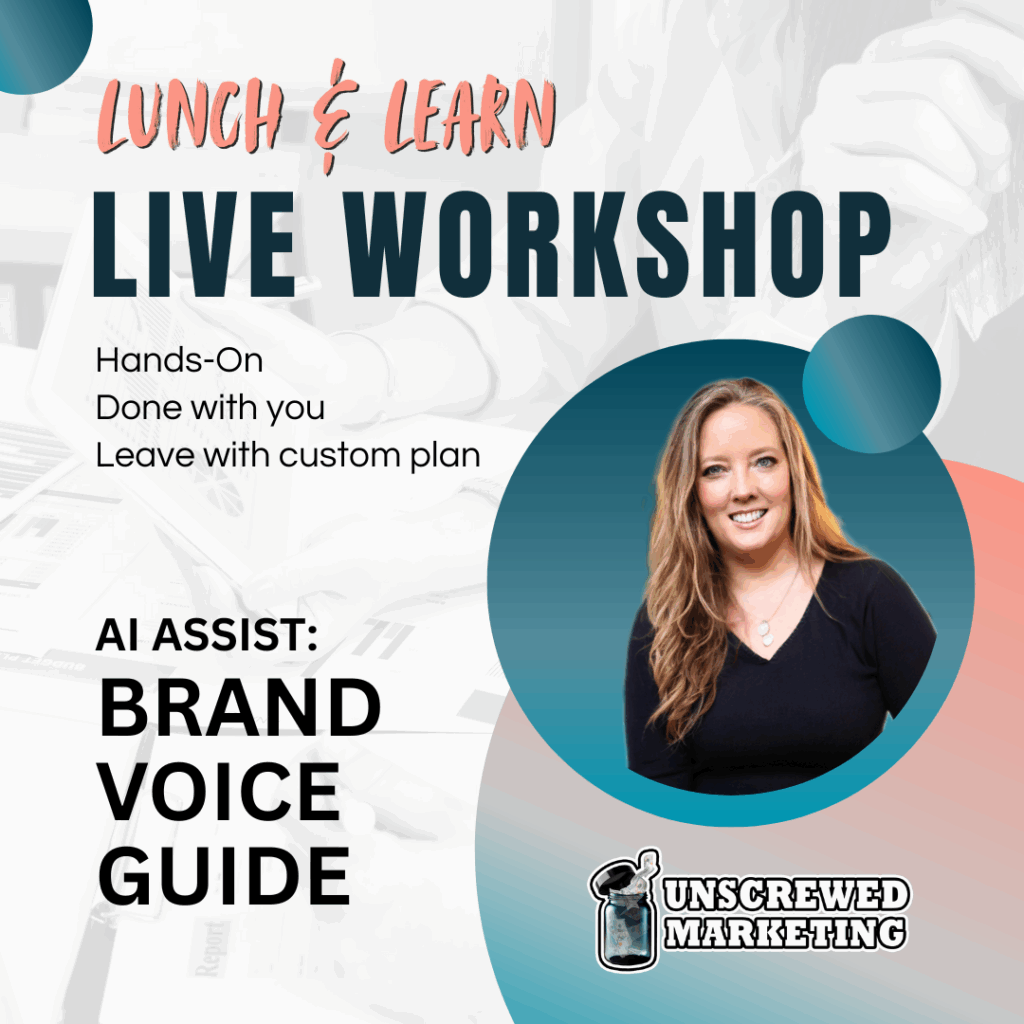
The Brand Voice Workshop is designed to uncover what makes your business different and turn that into messaging that attracts the right clients even when the market tightens.
Because when your voice is clear, your marketing becomes easier, more consistent, and far more resilient.
Leverage AI tools to create consistent and engaging content effortlessly.
Enhance your marketing strategy with clear, actionable phrasing.
Collaborate effectively with your team using a unified brand communication guide.
As Seen In


This website uses cookies to ensure you get the best experience on our website. By continuing to use the website, you agree to our use of cookies. We do not share or sell your information. More info