- +1 512-591-8295
- [email protected]
- Mon - Fri: 9:00 - 16:00
- +1 512-591-8295
- [email protected]
- Mon - Fri: 9:00 - 16:00
Use code MOM50 at checkout thru Mother’s Day to get 50% off any gift card for marketing services
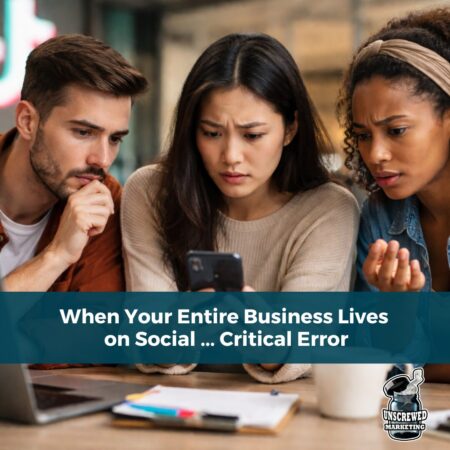
TikTok can feel like a goldmine for business growth. You see success stories everywhere. Accounts blowing up. Leads rolling in. Content getting traction faster than anything else you’ve tried. 100% of your sales coming from TikTok. When that happens, it’s incredibly tempting to pour all your energy into the platform and call it a strategy.
The problem is that momentum and stability are not the same thing.
The question most entrepreneurs don’t ask until something breaks is simple: what happens when the algorithm changes, the trends shift, or the platform decides your content no longer fits its priorities? When your entire business depends on a single third-party platform, you’re operating in a fragile position, whether it feels that way day to day or not.
This topic isn’t coming up again by accident.
As of January 2026, the U.S. version of TikTok has gone through a significant transition. Ownership and investor structure shifted, and with that came notable changes to TikTok’s U.S. privacy policies and enforcement language. At the same time, creators and businesses have been reporting increased content removals tied to sensitive or critical viewpoints, along with broader uncertainty about how moderation and visibility are being applied.
You will always want to review policy changes because they could literally update them five minutes after I write this post. But in general:
Some users perceive this as broader tracking or data collection than before, even if parts of it were technically in earlier versions; the explicit wording triggered pushback. Other related dynamics people mention (not strictly privacy policy but tied to trust):
None of this requires speculation or panic. But it does reinforce an uncomfortable truth entrepreneurs often ignore: periods of platform transition are historically when rules change fastest, enforcement becomes less predictable, and trust erodes the quickest.
Some businesses are being pushed out. Others are choosing to leave voluntarily. In both cases, the outcome is the same for anyone who built their entire operation on the platform. If TikTok was the foundation instead of a channel, everything feels shaky at once.
This is exactly why contingency planning matters, not just in the case of an outright ban, but any time reliance becomes too concentrated. I’ve written about this before in the context of preparing for a potential TikTok ban back in early 2025 when that was the primary discussion, but the same logic and planning applies if you decide to walk away on your own terms.
One of TikTok’s biggest psychological traps is how much control it feels like you have. You post consistently. You follow best practices. You watch your analytics. You adapt to trends.
And yet, your reach is still dictated by an opaque system you don’t influence, don’t see, and don’t get a vote in. Visibility is conditional, not earned. Doing everything “right” does not protect you from sudden drops, throttling, or shifts in distribution.
Entrepreneurs often mistake consistency for stability. They are not the same thing. Temporary visibility can disappear without warning, even when nothing on your end changes.
TikTok is rented attention. Full stop.
I’ve talked before about the critical nature of entrepreneurs getting customers and prospects off of these third-party platforms … anything where you do not own the hosting and underlying information.
You don’t own the audience. You don’t own the data. You don’t own the distribution. The platform does. And just like a landlord, it can change the rules, raise the rent, restrict access, or shut the door entirely without your consent.
Owning your audience means having a direct relationship outside the platform. An email list. A website that acts as a hub. Systems that allow you to communicate, sell, and serve without needing permission from an algorithm.
When access disappears on a platform you don’t own, it doesn’t just mean fewer views. It often means losing contact with your customers entirely.
This is usually the point where entrepreneurs push back. They’ll say, “Every one of my clients came from TikTok. That’s where my audience is. That’s where my business lives.”
And they’re not wrong.
The mistake isn’t being on TikTok. The mistake is assuming that because your clients found you there, your business has to live there too.
If 100% of your clients are on TikTok (or any third-party platform) and that platform bans you … then you have lost 100% of your clients.
TikTok can be where people meet you. It does not have to be where the entire relationship stays. When the platform is the only place that relationship exists, you’re not running a business, you’re borrowing one.
My own niece has a growing business that is almost entirely on TikTok. We briefly discussed the other day how she is considering moving most of that to some other similar platform, yet the issue there becomes the reason why TikTok, Amazon, and similar are so popular is because that’s where the audience already is. If the audience isn’t already on some other platform (at least not the same frequency or total time), it becomes exceedingly hard to actually reach the audience. If they have to come find you, they probably won’t bother.
The goal is not to abandon the channel your audience already uses. The goal is to stop letting that channel be the single point of failure.
If 100% of your clients came from TikTok, that’s actually a signal, but not a justification. It tells you the channel works for discovery. It does not mean it’s safe as infrastructure. Especially not primary infrastructure.
The healthiest businesses I see treat TikTok as the front door, not the building. People walk in there, but the real relationship, the sales process, and the long-term value live somewhere else. My niece is successfully embracing this concept and growing her business both on and off TikTok.
That shift doesn’t break what you’ve built. It protects it.
High engagement can feel like proof that your business is working. But engagement without insulation is risky.
If leads only exist as long as reach exists, revenue becomes fragile. When traffic drops, inquiries drop. When inquiries drop, sales follow. Businesses that rely on trends instead of systems often experience sharp swings instead of steady growth.
Viral does not mean durable. And visibility is not the same as infrastructure.
I’ve watched businesses thrive on TikTok for months, sometimes years, only to struggle the moment trends shifted or reach dipped. Traffic vanished overnight. Inquiries slowed. Revenue followed. There was no warning, no appeal process, and no leverage to pull.
The emotional and financial whiplash of platform dependence is real. It’s stressful, disorienting, and completely avoidable with the right foundation in place.
When entrepreneurs think about platform risk, for any platform, they often imagine the most dramatic scenarios. Bans. Platforms no longer allowing any type of selling. Total shutdowns of the platform. Worst-case headlines.
In reality, the more common risks are quieter. Algorithm changes. Policy enforcement shifts. Content moderation adjustments. Reduced visibility. Account limitations. Monetization changes you don’t control.
The most dangerous mindset is “it hasn’t happened to me yet.” That’s not a strategy. It’s a hope.
A single channel is not a strategy. Ever.
TikTok can absolutely play a role in your marketing, just like any other platform. But that role should be clear and limited. It should function as a traffic source, not a home base. Visibility should feed owned assets, not replace them. You don’t own TikTok.
This is where many entrepreneurs get TikTok wrong. They treat it like a foundation instead of what it really is: rented distribution. I’ve broken this concept of tiktok being rented distribution down more fully here, because the distinction matters.
When you approach TikTok the way you would paid ads, as a channel that sends people somewhere you control, the risk profile changes dramatically.
A stable business doesn’t rely on a single algorithm to survive. There is always plan B, and C, and contingencies.
A stable business has a website that acts as the central hub. Email and list-based relationships that don’t disappear overnight. Multiple discovery paths so no single channel can take the whole operation down with it. (The old “single-path funnel” is no longer applicable, either … your funnels are now an entire ecosystem).
These systems take longer to build than a viral video. But they last longer too.
This isn’t about quitting TikTok. It’s about claiming control of your business.
If TikTok disappeared tomorrow, would your business still function? Could you reach your audience? Could you generate leads? Could you sell?
Momentum is easy to chase. Stability is intentional. The businesses that last are the ones that build on what they own, not what they rent.
When you’re doing a lot but results still feel unpredictable, the problem isn’t effort.
In a focused one-on-one strategy session, we’ll identify what’s blocking progress, what to stop doing, and what deserves your attention next.
First strategy session available at one-time intro rate. Limited availability.
When everything feels messy, it’s almost always because one underlying issue is creating a dozen visible symptoms.
Find the real constraint in a 1:1 session so effort finally turns into momentum instead of more noise.
Your first strategy session is available at one-time intro rate. Limited availability.
More effort won’t fix misaligned focus.
Use a 1-on-1 strategy session to get clear on what’s actually helping, what’s quietly holding you back, and where attention will make the biggest difference right now.
Your first strategy session is available at one-time intro rate. Limited availability.
Scattered systems create fragile results.
In a 1-on-1 marketing strategy session you will see how the pieces should actually work together so progress doesn’t collapse the moment you stop pushing.
Your first strategy session is available at one-time intro rate. Limited availability.
Clarity isn’t about more ideas. It’s about knowing which moves matter now, which can wait, and which should never have been on the list.
Expertise will help you focus on what matters first in a 1-on-1 marketing strategy session.
Your first strategy session is available at one-time intro rate. Limited availability.
Let the pros handle your social media.
This website uses cookies to ensure you get the best experience on our website. By continuing to use the website, you agree to our use of cookies. We do not share or sell your information. More info