

Use code MOM50 at checkout thru Mother’s Day to get 50% off any gift card for marketing services
Most entrepreneurs who feel stuck in their marketing are not new, confused, or inexperienced.
They’ve tried things. Often a lot of things. SEO, content, email, social, ads, funnels, automation, now AI. Some of it worked. Sometimes it even worked well. But it never stacked. It stalled, fractured, or stopped compounding, and eventually they found themselves rebuilding instead of building forward.
It looks something like this:
That pattern is not accidental. It’s also most often not purposeful either. It’s structural.
What I see most often is not bad marketing execution, but marketing that was never designed as a system in the first place.
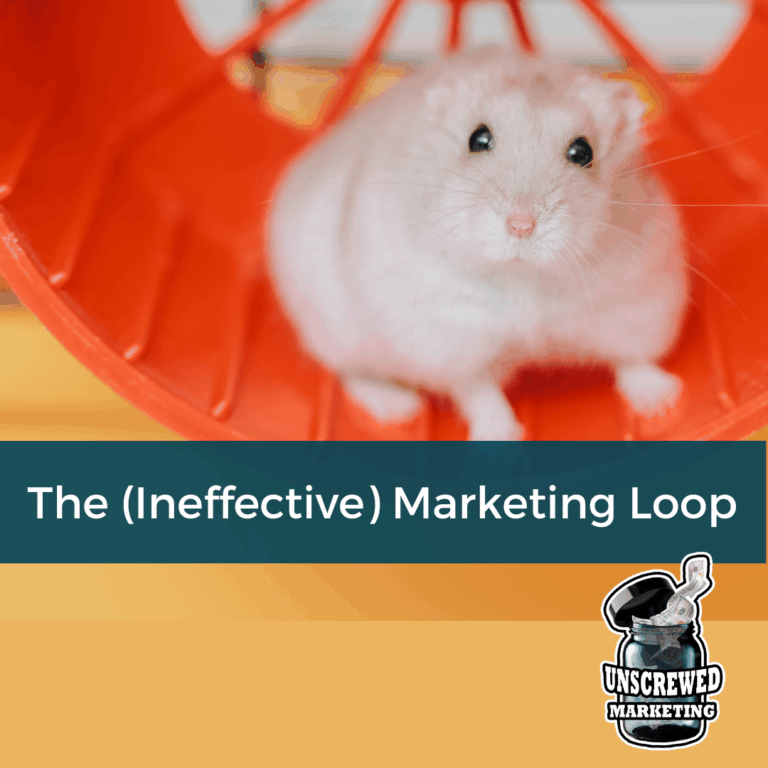
That’s what drops you into the endless marketing loop, which you can think of like the hamster wheel of marketing … no matter how much faster or longer you run, you still aren’t getting anywhere.
Entrepreneurs have been taught how to do marketing tactics. They haven’t been taught how to evaluate it, connect it, or decide what actually belongs together … the strategy.
When entrepreneurs talk about this, they rarely say “my strategy is wrong.” They say things like:
That confusion isn’t about effort. It’s about architecture.
Most marketing loops start the same way. A tactic shows promise. It generates different interest, traffic, or engagement. Results plateau. Instead of stepping back to evaluate the structure, another different tactic gets added. Then another. Eventually the business is running SEO, social, email, ads, and AI-driven content, using this framework and that, adding one software and another, without a clear understanding of how any of it is meant to work together.
What you used to do in one step now involves five with duplicated effort across different platforms.
That’s fragmentation. Not to be mistaken with momentum.
Most entrepreneurs are not short on tactics. They’re overloaded with disconnected ones.
Each piece can be “done right” in isolation. Together, they were never designed to function as a system.
AI has made this easier to miss. And actually made it more prevalent as well. You can now produce content, campaigns, and automations faster than ever, which encourages stacking before understanding how things should connect. The result is a marketing ecosystem that looks busy and sophisticated but feels fragile and unpredictable.
I’ve talked before about how what used to be thought of as “funnels” now needs to be viewed as an entire “ecosystem”. The good that is that this type of integrated marketing is STRONG. The bad thing is that also means there are more points at which something can get off whack. Think of a rainforest, which is a complicated ecosystem; if something happens to one species, that often impacts another. And your business is a complicated ecosystem.
AI is not the problem for entrepreneurs. How it’s being used is.
Most entrepreneurs are using AI to fill strategic gaps instead of amplify strategic decisions. They turn to AI as an expert … but it’s not an expert in anything. All it can do is regurgitate what everyone else says (not does, critical distinction.) It speeds up execution without improving clarity. That’s why businesses now have more output, more automation, and more dashboards, yet less confidence in what actually drives revenue.
AI doesn’t decide what matters. It doesn’t understand what matters. The AI we have today isn’t actually “artificial intelligence”. It’s a “large language model” … it has learned how people usually write. Writing is not strategy. Writing is not decisions. Writing is not expertise. It can accelerate whatever structure already exists. If the structure is unclear, AI scales that confusion efficiently.
Ouch.
When AI is introduced before decisions are made about audience, messaging, and path to purchase, it locks in misalignment instead of solving it.
This is where capable entrepreneurs tend to get trapped.
None of these are bad. The issue is that they’re taught independently, without addressing how they’re meant to coexist inside a real business.
You’ll notice I don’t sell a lot of “frameworks” here. Or if I share those, they’re carefully designed by me to integrate into everything else you likely already do.
Courses teach tactics. They rarely teach integration. Even with my courses, it’s hard to teach you exactly how to integrate it *best* because your business is unique, and that integration needs to be unique as well.
But when you don’t properly integrate, you end up with a Frankensteined marketing stack made up of “best practices” that were never designed to compound together.
When an entrepreneur asks me why it isn’t working, the answer is usually simple: it was never built as a whole. You’re not the problem.
Learning is always valuable. Entrepreneurs should be learning. Constantly!
The problem is that no one teaches how to weave that new knowledge into what already exists. Every new insight becomes a rebuild instead of a refinement. Marketing stays perpetually in progress, constantly adjusted but never stabilized.
It is something that does always need to change. But not because it’s an awkward sticking point, just because business, environment, audience, industry, LIFE changes.
At a certain point, DIY stops creating leverage and starts delaying clarity.
Like when you need to grow. The point that most entrepreneurs get real serious is where they often first realize what they have may also cause a growth bottleneck.
Entrepreneurs are executing marketing without marketing strategy-making expertise.
There’s no clear way to determine what belongs, what’s misaligned, or what should be removed entirely. No criteria for deciding which channels deserve attention, automation, or investment. Without that, everything feels necessary and nothing feels finished.
Sometimes it’s not even possible to be able to make those best choices unless you have the deep experience.
That’s the loop.
When structure exists, marketing stops feeling heavy.
Growth becomes steadier because the system was designed to compound.
Questions That Can Help You Break Free
Instead of adding more, simplify and focus on what actually drives results. Ask yourself:
The businesses that grow the fastest aren’t doing the most marketing—they’re doing the right marketing.
Many entrepreneurs try to do everything themselves—watching tutorials, buying courses, and testing strategies. And while learning is great, high-level marketing takes years of experience to master.
This is exactly a gap The Unscrewed Room is built to address.
Not by just adding tactics or handing out another framework. But by helping entrepreneurs see what they already have, what doesn’t belong, what’s misaligned, and how to make the entire system work together.
That’s how the loop actually breaks.
Ready for a Smarter Way to Grow?
Ever feel like your marketing should be working better than it is? You’re not alone—and you’re not stuck.
Most businesses are working hard—but still missing the right strategic support.
Step into The Unscrewed Room—where growth-minded entrepreneurs get expert insights, no-fluff tools, and real guidance.
As Seen In


This website uses cookies to ensure you get the best experience on our website. By continuing to use the website, you agree to our use of cookies. We do not share or sell your information. More info